In this edition of our newsletter, corresponding to the second quarter of 2025, we present an updated overview of the main reforms, initiatives, and judicial criteria in labor matters.
1. Reduction of the Workweek
The reduction of the workweek from 48 to 40 hours remains one of the key topics on the labor agenda in Mexico. Although the relevant legal reform has not yet been approved, this quarter saw significant progress outlining the path for this controversial initiative. On Labor Day (May 1, 2025), the federal government officially announced that the 40-hour workweek will be implemented gradually, with full implementation targeted for January 2030.
President Claudia Sheinbaum instructed the Ministry of Labor and Social Welfare (STPS) to immediately begin the necessary actions for gradually reducing the workweek and reaching the objective by the end of her six-year term. Labor Secretary Marath Bolaños confirmed in a meeting with labor unions that the reduction will be “gradually implemented until, no later than January 2030, a total of 40 hours per week is reached.”
This announcement clarified the strategy: there will be no sudden cut from 48 to 40 hours, but rather a phased approach. While the specific steps were not publicly disclosed, unofficial sources suggest a potential reduction of 1 hour per year starting in 2025 or other gradual adjustment models agreed upon with the productive sector. The rationale for this gradual process is to give companies time to adapt without disrupting productivity or increasing costs abruptly, while fulfilling campaign promises and aligning Mexican legislation with international standards.
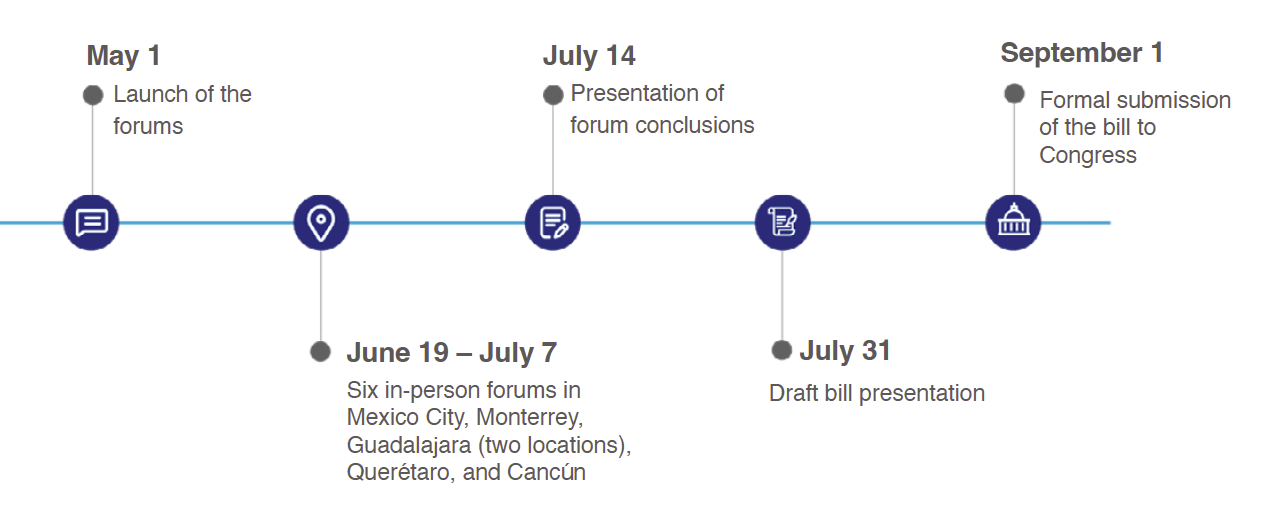
From a legislative standpoint, the reform requires amendments to Article 123 of the Constitution to reduce the maximum workweek and increase weekly rest days from one to two. This initiative was introduced in 2023 and has sparked wide public debate; however, it was not approved during the regular April session. As a result, the STPS, in coordination with the Chamber of Representatives and other stakeholders in different productive sectors, launched the National Tour for the 40-Hour Week—an exercise in social dialogue forming part of the process to draft a formal legislative proposal. This process is expected to unfold as follows:
It is worth noting that with a 48-hour workweek, Mexico has the longest maximum workweek in the OECD, tied with Colombia. Meanwhile, 24 out of 38 OECD countries already limit the workweek to 40 hours or less. The reform aims to close this gap with developed economies in terms of work-life quality and hourly productivity.
2. Entry into Force of the “Chair Law”
On June 17, 2025, the reform to the Federal Labor Law (LFT), known as the “Chair Law,” will take effect. Published in December 2024, it establishes new employer obligations aimed at guaranteeing the right to rest during the workday. The reform particularly targets the commerce, services, and light manufacturing sectors, where it is common for workers to remain standing for long periods.
The reform amended Article 132 of the LFT to require employers to provide chairs with backrest in appropriate places so workers can sit while performing their duties—when the nature of the work allows—or during breaks. Article 133 was also amended to explicitly prohibit employers from preventing workers from using chairs. Additionally, Internal Work Regulations must now include specific provisions on the use of backed chairs in applicable positions.
Once in effect, labor inspections may verify compliance with this obligation, including the presence of ergonomic backed chairs in fixed workstations and designated break areas.
3. Judicial Elections
On June 1, 2025, extraordinary elections for the Judiciary were held nationwide, from 8:00 a.m. to 6:00 p.m. Unlike regular federal or local elections, this day was not considered a mandatory paid holiday due to its extraordinary nature.
As a result, workers who worked that day are not entitled to extra compensation unless it coincided with their regular Sunday shift, in which case the usual Sunday premium must be paid.
4. Platform-Based Work
The reform to regulate work performed through digital platforms will take effect on June 23, 2025. This reform adds a new chapter to the LFT titled “Work on Digital Platforms,” and outlines the elements defining this type of labor relationship: subordination, remuneration, and the use of information technologies for work management and supervision. Although the final text was approved in December 2024, it’s important to recall the key highlights of this reform:
- Recognition of Employment Relationship: A labor relationship exists when a worker earns a net monthly income of at least the monthly minimum wage (MX$8,364 in 2025), regardless of the actual hours worked. Those below this threshold are considered independent workers but are still entitled to the chapter’s rights—except social security contributions, unless related to workplace risks, which must be covered by the platform.
- Wages and Benefits: Wages will be calculated per task or service and must be paid within a week. This includes proportional payments for weekly rest, vacation, vacation premium, year-end bonus, and overtime. No additional compensation is due for these concepts. Workers who exceed 288 hours of work per year will also be entitled to profit-sharing.
- Contracts and Algorithmic Oversight: Relationships must be formalized through a digital contract registered and approved by the Federal Center for Labor Conciliation and Registration. Platforms must also disclose their algorithmic task assignment and decision-making policies via a mandatory algorithm management policy.
- Termination and Disconnection: Clear rules are established for terminating employment, including protection against unfair automated decisions. Inactivity for 30 consecutive days will end the relationship without liability for the employer.
- Key Prohibitions: Platforms are prohibited from charging workers to use the app or simulating civil/commercial contracts to evade labor obligations.
This reform places Mexico among the first Latin American countries to create a specific legal framework for platform-based work, aiming to balance the model’s flexibility with basic labor protections. Platforms must significantly adjust their operational and contractual models to comply.
As part of implementation, the STPS and IMSS will launch the Mandatory Pilot Program for IMSS Enrollment on June 27, 2025, alongside the publication of IMSS operating rules and STPS guidelines to define net income. This will enable all platform workers to access full social security coverage regardless of income level.
5. Reform Proposal for Working Conditions in the Service Sector (“Tips Law”)
On April 29, 2025, a reform proposal to the LFT was introduced with the aim of strengthening labor rights protections for workers in hotels, restaurants, bars, sports and entertainment centers, fuel stations, and similar establishments. The proposal establishes specific guidelines for wages, the handling of tips, and their fair distribution. Key points include:
- Minimum Wage Irreducibility: The minimum wage cannot be replaced by tips, voluntary gratuities, commissions, or any other additional income. All workers must receive the mandatory minimum base wage, regardless of any tips earned.
- Employer Prohibition on Tip Retention: Employers are strictly prohibited from withholding, using, or participating in tips earned by workers. Tips must be distributed proportionally based on the actual time and work performed by the employees generating them.
6. Recent Judicial Criteria
Here are two court rulings published this quarter that are particularly relevant for managing labor disputes and ensuring regulatory compliance:
- IMSS Enrollment Does Not Prove Ongoing Employment (Digital Record: 2030285): Federal courts ruled that keeping a worker enrolled in IMSS after an alleged dismissal is not sufficient proof that the employment relationship continues. Since this is a unilateral act by the employer, it does not necessarily reflect the employment reality. Additional evidence is required to challenge an unfair dismissal claim (e.g., witnesses or pay stubs). This underscores the need to document the start and end of employment properly.
- Benefits in Cases of Permanent Disability (Digital Record: 2030298): In lawsuits for permanent disability, courts established that IMSS must pay all pension-related benefits, even if they are not explicitly requested in the complaint. Based on the pro persona principle, this expands the court’s ruling to include retroactive payments and family allowances. For companies, this may impact litigation related to work-related illnesses or accidents, in addition to any potential joint liability.