On the occasion of the beginning of the year 2026, we share with you the key issues to consider in labor matters.
Continue reading

On the occasion of the beginning of the year 2026, we share with you the key issues to consider in labor matters.
Continue reading
Following the reform to the Federal Labor Law (“LFT”) regarding subcontracting, the Ministry of Labor and Social Welfare (“STPS”) has issued a series of provisions and guidelines, through the General Directorate of Federal Labor Inspection (“DGIFT”), to oversee and promote compliance with labor regulations.
In this context, on November 24, 2025, the STPS published the Inspection Protocol on Subcontracting (the “Protocol”), which aims to describe the procedure and indicators federal labor inspectors must apply to verify legal compliance, establishing guiding criteria regarding regulatory scope and the actions of the labor authority in carrying out its oversight duties in this area.
Continue reading
Nos complace compartir el artículo, escrito por nuestro socio Emilio Garzón, recientemente publicado en la 17ª Edición de The Legal Industry Reviews (Junio 2025).
¿Está tu empresa preparada para una inspección laboral?
En México, las inspecciones por parte de la Secretaría del Trabajo y Previsión Social (STPS) se han vuelto más frecuentes y rigurosas, especialmente en su modalidad extraordinaria. Estas visitas pueden tener implicaciones importantes tanto legales como económicas para los centros de trabajo.
En este artículo, nuestro Socio Emilio Garzón de Marván, González Graf y González Larrazolo analiza a fondo el procedimiento de inspección laboral, los plazos clave, las posibles sanciones y las mejores prácticas para que las empresas estén preparadas y puedan actuar con oportunidad.
Te invitamos a leer el análisis completo y conocer cómo enfrentar una eventual inspección de forma informada y estratégica.a manera en que se gestionan los despidos en México. ¿Cómo afectará esto a trabajadores y empleadores? ¡Descúbrelo en el artículo completo! (página 58).

During the first quarter of the year, several reforms to labor legislation were published, among other provisions in the field, reigniting legislative debate on various initiatives planned for implementation. In this newsletter, we share with you relevant legislative updates, legal criteria, and pending initiatives.
Continue reading
During the first quarter of the year, several reforms to labor legislation were published, among other provisions in the field, reigniting legislative debate on various initiatives planned for implementation. In this newsletter, we share with you relevant legislative updates, legal criteria, and pending initiatives.
Continue reading
Nos complace compartir el artículo, escrito por nuestro socio Santiago Marván Urquiza, recientemente publicado en la 16ª Edición de The Legal Industry Reviews (Febrero 2025).
La Segunda Sala de la Suprema Corte de Justicia ha confirmado la validez de la reforma al artículo 47 de la Ley Federal del Trabajo (LFT), estableciendo que la falta de entrega del aviso de despido solo genera una presunción de despido injustificado, pero permite que el patrón pueda demostrar lo contrario.
Históricamente, la LFT exigía a los empleadores entregar un aviso escrito a los trabajadores despedidos, y su omisión implicaba que el despido se considerara injustificado. Sin embargo, con la reforma de 2019 y la reciente resolución de la Suprema Corte, se flexibiliza el proceso para los patrones, permitiéndoles justificar el despido en juicio aún sin haber entregado el aviso por escrito.
¿Qué significa esto?
Ésta decisión impacta directamente en las relaciones laborales y en la manera en que se gestionan los despidos en México. ¿Cómo afectará esto a trabajadores y empleadores? ¡Descúbrelo en el artículo completo!

Nos complace compartir el artículo, escrito por nuestro socio J. Genaro Pérez Velázquez, recientemente publicado en la 12ª Edición de The Legal Industry Reviews (Julio 2023).
El derecho laboral en México siempre ha defendido el principio de la estabilidad en el empleo. Pero, con las recientes reformas, estamos presenciando cambios considerables en este principio:
Las reformas buscan agilizar los procesos y reducir tiempos y costos, pero es esencial estar bien informado. Conozca más detalles en nuestro artículo completo y manténgase actualizado en este ámbito tan crucial.

Nos complace compartir un articulo publica en la revista “Legal Industry Reviews” sobre la aprobación del proyecto de la NOM 037 en Materia de Teletrabajo, con autoría de Beatriz Higareda.
El Comité Consultivo Nacional de Normalización de Seguridad y Salud en el Trabajo ha aprobado el proyecto final de la NOM 037-STPS-2022 en Materia de Teletrabajo, Condiciones de Seguridad y Salud en el Trabajo. El objetivo principal de esta Norma es establecer las condiciones de seguridad y salud para prevenir accidentes y enfermedades para los trabajadores que prestan servicios en la modalidad de Teletrabajo. +
Entre las obligaciones establecidas se encuentran contar con un listado de teletrabajadores, asegurarse de que el lugar de trabajo cuente con condiciones óptimas de conectividad, comunicación y seguridad, establecer una política de Teletrabajo, informar a las personas en Teletrabajo sobre exposición a agentes y factores de riesgo, documentar el proceso de implementación de Teletrabajo, proporcionar herramientas necesarias, entre otros. La Norma Oficial entrará en vigor a los 180 naturales posteriores a su publicación en el Diario Oficial de la Federación.

On April 25, 2023, the Commission of Constitutional Matters of the Chamber of Representatives approved and sent to the Plenary Session of said Chamber, for discussion and approval, if applicable, the "Ruling on the initiatives with draft decree proposing the amendment of Article 123 of the Political Constitution of the United Mexican States, regarding rest days".
The draft decree is justified on the impact that workers have on their health, family cohesion and social relations, as a result of working hours and the lack of rest days, as well as the recommendations issued by the International Labor Organization (ILO).
The initiatives analyzed by the Commission included the proposal to reduce the daily workday from 8 to 7 hours, as well as amendments to Section B of Article 123 of the Constitution (which applies to workers at the service of the State); however, in the opinion approved by the Commission it was proposed to amend only the text of Article 123 Section A of the Political Constitution of the United Mexican States, in order to reduce the working days to five, increase the rest days to two, in other words, for five days of work there would be two days of rest, which implies that the weekly workday would be of 40 hours.
The legislative process will have a recess, since the first ordinary period of sessions has concluded and will continue in the second ordinary period of sessions that will begin in September 2023, at which time the draft Decree may be considered for voting.
It is unlikely that the draft decree will be considered for a special session, since in order to summon a special session, it must be done by two-thirds of the Permanent Commission of the Congress or by the President of the Republic.
This is a Constitutional reform, so its approval requires the vote of two thirds of the legislators, both in the Chamber of Deputies and subsequently in the Senate, and the reform must be approved by the majority of the Local Congresses.
The reform would not only impact work centers that work six days and one rest day, since according to the Federal Labor Law there are workplaces that work 5 days with 2 rest days, but the sixth day is divided into 5 days to work 9.5 hours a day from Monday to Friday and, with the proposed reform, those work centers would have to reduce the workday to 8 hours a day.
However, it is worth reviewing how the working week is regulated in Latin American countries:
| Countries | Maximum weekly working hours |
|---|---|
| Argentina, Bolivia, Costa Rica, Nicaragua, Panamá, Perú y Uruguay | 48 |
| Guatemala, Honduras, Cuba, República Dominicana, Brasil y Venezuela | 44 |
| Ecuador | 40 |
En Europa:
| Countries | Maximum weekly working hours |
|---|---|
| Holanda | 48 |
| España, Bélgica, Italia, Polonia y Suecia | 40 |
| Dinamarca | 37 |
| Francia, Suiza y Alemania | 35 |
There is a legislative tendency to reduce the working week, as in the case of Chile, where in March this year they reduced the working week from 45 to 44 hours and will reduce it to 40 hours in 2028. There are even more aggressive plans, such as in England, where in June 2022, 71 companies changed to a four-day workday as part of a pilot program. Colombia will gradually reduce the number of working hours per week, starting at 47 in 2023 and ending at 42 in 2026.
During this waiting period it is possible that, in view of the stances of the sectors involved, the draft decree will have a new analysis, since it implies a high impact on the life of the Companies, both economic and operational, generating the challenge of modifying the ways of working to comply with the reform, and in turn, guarantee the efficiency of their operation.
Thus, Mexico will experience a debate in which political interests in the run-up to the presidential elections will put pressure on Congress and the State legislatures to approve the reform, disregarding the fact that it entails a high cost and loss of competitiveness in the face of possible investments. Although it is difficult to anticipate a scenario, it is possible that the party in power will be satisfied with the proposed initiative and the electoral and media projection it gives it, without the detriment to labor competitiveness that approving the reduction of the workweek would represent.

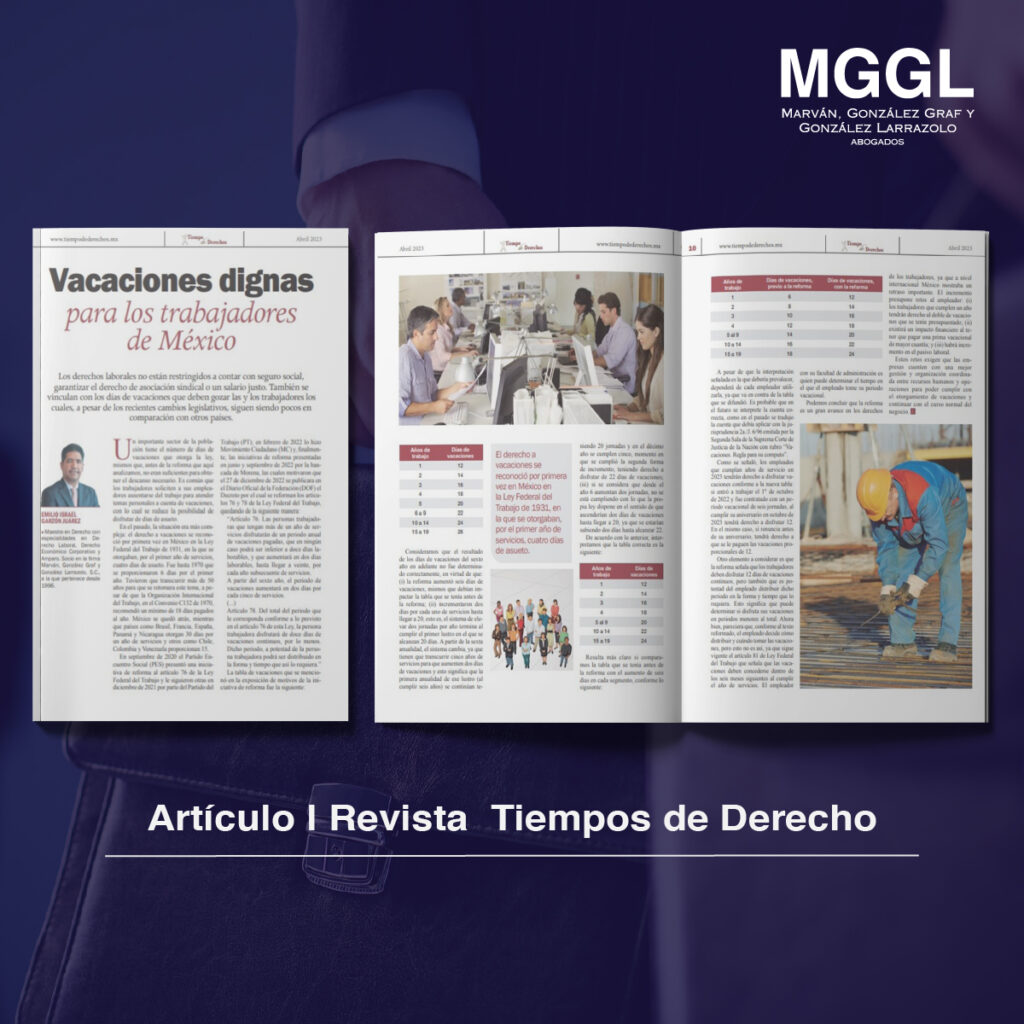
Los derechos laborales no están restringidos a contar con seguro social, garantizar el derecho de asociación sindical o un salario justo. También se vinculan con los días de vacaciones que deben gozar las y los trabajadores los cuales, a pesar de los recientes cambios legislativos, siguen siendo pocos en comparación con otros países.
En un artículo publicado en Tiempo de Derechos (ed. No.60 – abril 2023), Emilio Garzón, Maestro en Derecho con especialidades en Derecho Laboral, Derecho Económico Corporativo y Amparo, y Socio en nuestra firma, habla de los avances en los derechos de los trabajadores en México, y de los retos importantes para empleador.
Consulta el artículo here.